
Enigma, Ultra, and How Intelligence Won the War
How Computing Turned the Tide of WWII Through Information, Innovation, and Insight

To identify a single moment in World War II as the turning point is impossible. Millions of participants determined the war's outcome across thousands of events. Despite this, certain events significantly affected the outcome of the war, one of which was the breaking of the German Enigma code. Until July 9, 1941, the day the Enigma code was broken, Germany had a massive communications advantage. The Germans sent hundreds of encrypted messages daily in real-time, describing bombing runs, U-boat attacks, and the location of minefields, which anyone could intercept but no one could understand. Germany was winning the war through technology, and no amount of gunfire or bloodshed could do anything about it. Breaking the Enigma code was a major turning point in World War II because it provided the Allies with invaluable information about the enemy’s plans and knowledge, ensured the safety of transatlantic convoys, and had an undeniable influence on the outcome of pivotal battles such as Stalingrad and the invasion of Normandy.
Due to Germany’s overconfidence in Enigma, the Allies had a completely uncorrupted view of German plans and the enemy’s knowledge of Allied plans. Mathematician Hannah Furness writes in How Long Would It Take You To Crack The Enigma Machine that if the entire population of the world, approximately 7.8 billion people, tried a combination of the Enigma machine every second, it would take 646 years to try every possible combination (Furness). The Germans rotated the settings every day at midnight, and the first messages went out at 6 a.m., meaning the Allies only had six hours a day to try to crack the code. To the Germans, their blind faith in the Enigma code was justified because it was humanly impossible to break, considering there were 158,962,555,217,826,360,000 possible combinations for it daily (Furness). The likelihood of finding the solution would be like picking up a single grain of sand from a beach and having it be the exact one you needed. Alan Turing and the Bletchley Park team had to invent never-before-seen technology to break the code: the project’s codename was Ultra. The Germans could never have known that a non-existent device would crack their code, so they trusted Enigma completely. In The Historical Impact of Revealing the Ultra Secret, Harold Charles Deutsch, who was the head of research during World War II for the US Office of Strategic Services, states, "Ultra could be counted [as] the sole source of intelligence that had never been compromised by bluffs, feints, and deceptions on the part of the enemy. It spoke ‘from the horse's mouth,’ and there was no need to fear that the animal might be of the Trojan variety" (Deutsch). Unlike the Allies, the Germans did not rely on misinformation, as they believed they were the only ones who could decipher Enigma’s messages. The Germans relied on Enigma for everything, and the Allies knew the information they decrypted was untainted, making it all the more valuable.
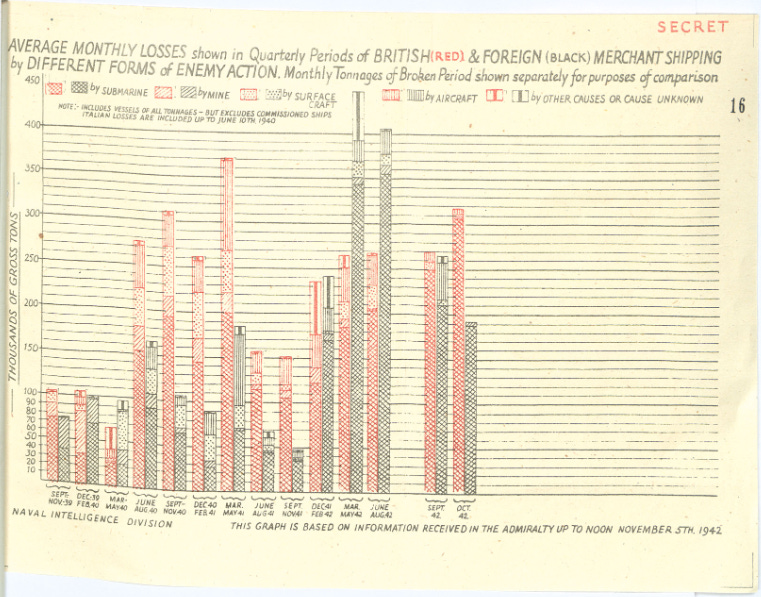
Another impact of the Enigma code was that it unlocked Germany’s vice-like grip on the Atlantic. Historian Gavin Mortimer writes in The Battle of the Atlantic: Why Britain Almost Lost to Hitler's U-boats that during World War II, Britain imported 70 percent of their food to keep the nation from starving, as well as metals essential for the war effort. It was devastating when, in just three months, they lost 700,000 tons of supplies (Mortimer). Transatlantic convoys were crucial to running Britain’s war effort. Food, ammunition, ships, planes, and tanks had to come from North America, but heavily patrolled U-boat channels prevented Britain from getting these essential supplies. The Germans also used tactics like placing underwater minefields and communicating where they were through Enigma. The Enigma code was broken on July 9, 1941, and subsequently, the amount of British shipping destroyed decreased significantly. In the graph, Average Monthly Losses of Merchant Shipping by Different Forms of Enemy Action (see Appendix A), it can be seen that the number of tons of British shipping destroyed drastically decreased from 370,000 tons from March to May of 1941 to 155,000 tons from June to August of 1941. Until that point, British losses exceeded German losses; after, German losses consistently exceeded British ones (Naval Intelligence Division). By then, the Allies knew where the U-boats were located and how to avoid the minefields so their ships’ essential supplies could reach Britain’s harbors. However, the Allies faced a dilemma they could not ignore: if they acted on all the information they obtained through the Enigma code, the Germans would realize it had been broken and alter the machine. Keeping that in mind, the Allies had to maintain a delicate balance between sacrificing enough ships so the Germans would not get suspicious and saving enough ships to ensure adequate supplies to fuel the war effort.
Acting on decrypted German communications, the Allies secured victory at World War II's major turning points, such as the Battle of Stalingrad and the invasion of Normandy. The official biographer of Winston Churchill, Martin Gilbert, wrote in Golden Eggs: The Secret War, 1940–1945, Part II: Intelligence and the Eastern Front that decrypted Enigma messages contained precise details of the strength and location of the German summer offensive at Stalingrad (Gilbert). The German army, the Wehrmacht, is widely known to have been the most effective fighting force at the time, especially compared to the Soviet military, which was poorly equipped, hungry, and inexperienced. However, the Allies were able to compensate for this with forewarning. The Soviet High Command received details on German plans as quickly as the German commanders on the front due to the code-breaking efforts at Bletchley Park, and without this, it probably would not have been possible for them to win this crucial battle. Brigadier E. T. Williams states in Volume, Security, Use, and Dissemination of Ultra, "[Ultra] was the only source revealing the enemy’s reactions to a cover plan. Without Ultra, we should never have known. In the case of ‘Fortitude’ (the Pas de Calais cover plan), it is arguable that without Ultra confirmation that it was selling, the plan might have been dropped" (Williams). One of the understated aspects of breaking the Enigma code was that it allowed insight into German knowledge of Allied plans. The invasion of Normandy succeeded because it was kept secret. The Allies looked to the codebreakers at Bletchley Park to confirm that the Germans had fallen for their cover operation. Decrypted messages confirmed that the Germans did not suspect an invasion at Normandy, and thus the Allies carried out Operation Overlord and won one of the most decisive victories of World War II.
World War II was more than a war of bombs and bloodshed; it was a war of information. Wartime often spurs innovation, and not only did breaking the Enigma code change the course of the war, but the world’s first computer, which was made to break it, changed the course of human history. Although this technology was born during wartime to defeat the Germans, the positive impact of computers today is undeniable, and Alan Turing’s invention is now a part of everyday life.
Appendix A
Amount of British and Foreign Shipping Destroyed During World War II
Works Cited
Deutsch, Harold C. “The Historical Impact of Revealing The Ultra Secret.” National Security Agency, 26 Oct. 2006, www.nsa.gov/portals/75/documents/news-features/declassified-documents/cryptologic-spectrum/ultra_secret.pdf. Accessed 24 March 2023.
Furness, Hannah. “How Long Would It Take You to Crack the Enigma Machine.” The Axiom, School of Mathematics, University of East, 20 Sept. 2021, the-axiom.uk/how-long-would-it-take-you-to-crack-the-enigma-machine/#:~:text=Even%20if%20we%20took%20the,try%20every%20single%20possible%20combination! Accessed 24 March 2023.
Gilbert, Martin. “Golden Eggs: The Secret War, 1940-1945 Part II: Intelligence and the Eastern Front.” International Churchill Society, 24 Apr. 2013, winstonchurchill.org/publications/finest-hour/finest-hour-150/golden-eggs-the-secret-war-1940-1945-part-ii-intelligence-and-the-eastern-front/#:~:text=Churchill%20ensured%20that%20Stalin%20was,of%20the%20battle%20of%20Stalingrad. Accessed 24 March 2023.
Mortimer, Gavin. “The Battle of the Atlantic: Why Britain Almost Lost to Hitler's U-Boats.” HistoryExtra, 27 May 2020, www.historyextra.com/period/second-world-war/did-britain-almost-lose-battle-atlantic-ww2-athenia-sinking/. Accessed 24 March 2023.
Naval Intelligence Division. “Average Monthly Losses of Merchant Shipping by Different Forms of Enemy Action.” The National Archives, www.nationalarchives.gov.uk/cabinetpapers/themes/maps-interactive/resource-downloads/cab66-31-wp42-521.jpg. Accessed 24 March 2023.
Williams, E. T. “Volume, Security, Use, and Dissemination of Ultra.” Defense Visual Information Distribution Service, 5 Oct. 1945, media-cdn.dvidshub.net/pubs/pdf_63808.pdf. Accessed 24 March 2023.
Great read. Turing is perhaps the most under-appreciated person in history.